

Summiting Mera Peak
Mera Peak (6,476m) is the highest trekking peak in Nepal. This mountain sits on the edge of Khumbu region which is steeped in mountaineering history.
We like to take the less travelled route to Mera Peak Base Camp. After an exciting flight from Ramechhap to Lukla, we head south to the remote region of the Hinku Valley. We trek through Pangkongma and Nashing Dingma villages getting to enjoy the sites and sounds of traditional Nepalese life. This route brings us around, rather than over the Zatrwa La Pass (4,630m). We have planned this route to ensure that the team is properly acclimatised before our summit attempt. We spend 11 days trekking to Base Camp, visiting ancient monasteries along the way and allowing for two rest and acclimatisation days.
Once we arrive at Mera Peak it is a technically straightforward mountain to climb. The main challenges being proper acclimatisation and weather. Our itinerary includes spare summit days to facilitate these adverse conditions. Poor snow conditions can make the summit day very challenging but the view from the summit is one of the best in all the Himalayas. On a clear day we will be able to see hundreds of huge peaks; including five of the world’s six highest peaks, Everest (8,848m), Lhotse (8,516m), Cho You (8,201m), Makalu (8,481m) and Kangchenjunga (8,586m).
Mera Peak is ideal for those with a good level of fitness and a keen sense of adventure! Previous experience on mountains above 5,000m is essential. Treks like Kilimanjaro or Everest Base Camp are ideal experiences for this.
You can read more about Mera Peak on our blog.
Want to learn even more? Watch our Mera Peak vlog here!
Note: The itinerary is subject to change due to the unpredictable nature of adventure travel. Adjustments may be necessary due to weather or other unforeseen circumstances.

Mera Peak Expedition Costs & What’s Included
The total expedition price is shown above.
Just pay a €399 deposit to secure your place. A part-payment of €1,000 is due six months before departure, with the remaining balance due three months before departure.
You can choose to pay the balance in instalments or in full.
Before You Go
- Pre-departure training weekend in Wicklow, Ireland
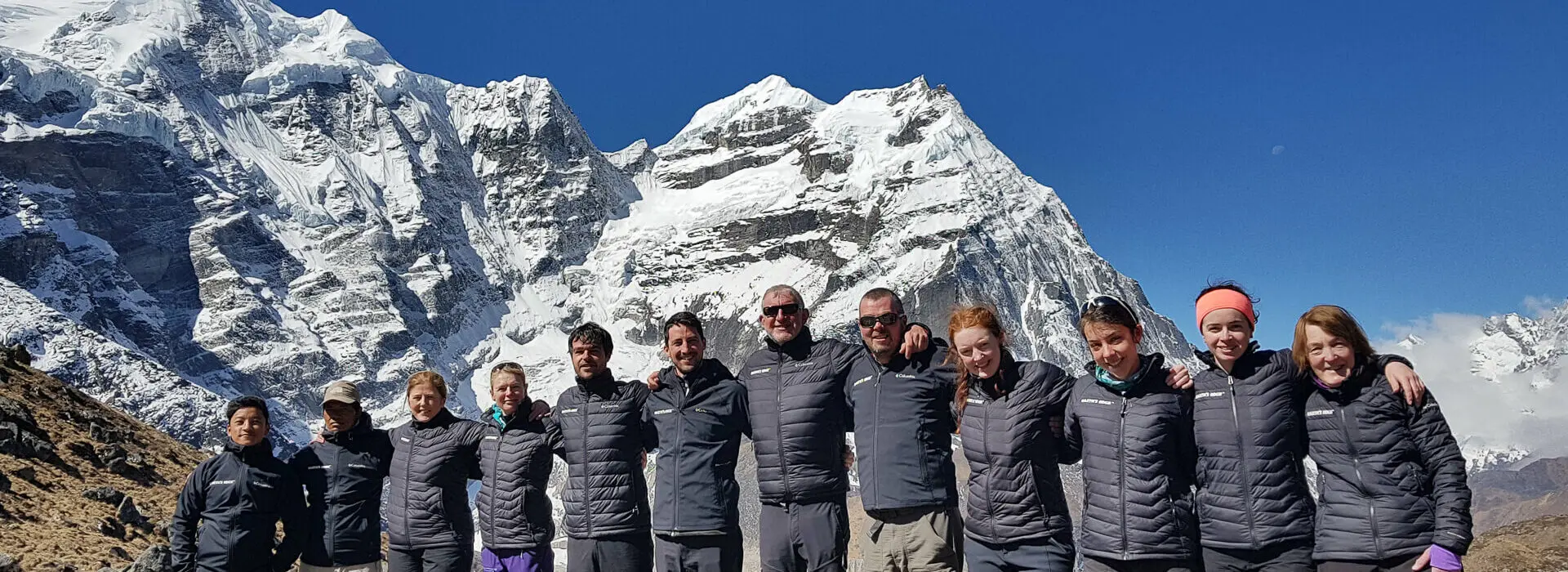
- An Earth’s Edge team jacket, buff and cap for you to keep
- Ongoing pre-departure support from the Earth’s Edge team
- Advice on training, equipment and preparing for altitude
In Nepal
- Highly experienced Nepalese Expedition Guide and mountain guiding team
- Dedicated Earth’s Edge expedition doctor
- Internal flights between Ramechhap and Lukla
- All accommodation based on twin sharing in hotels in Kathmandu, tea houses on the trail and camping at higher altitudes.
- All meals and drinking water except in Kathmandu and Ramechhap where accommodation is based on B&B
- Celebratory dinner at the end of the expedition
- Planned group transport throughout the trip
- Airport transfers that match our recommended flights
- Required trekking permits
- Fully stocked expedition medical kit
Flights
Flights to Nepal are not included in the expedition price.
Travelling from Ireland? We’ll send you our recommended flight timings approximately 10 months before departure. These are designed to connect with our complimentary group airport transfers.
You are, of course, welcome to choose alternative flights that suit you better. Just make sure you arrive in Kathmandu in time for the expedition briefing on Day 1.
Read our Mera Peak blogs
Do you fancy having more information on this expedition? We have lots of extra insight into our Mera Peak trips on the blog.
Itinerary
Day 1
Arrive in Kathmandu.
↓
Arrive in Kathmandu in time for your expedition briefing. Overnight hotel.
Day 2
Transfer to Ramechhap 5 hrs; Fly Ramechhap to Lukla, 35 minutes; Trek Lukla to Poyan, 3 hrs
↓
Early morning transfer to Ramechhap. Fly to Lukla and trek to Poyan village.
Day 3
Poyan to Panggom, 8 hrs
↓
We start the day descending and arrive to Kharte by lunch. In the afternoon we ascend to Panggom. Altitude 2,846m.
Day 4
Panggom to Najingdingma, 8 hrs
↓
We begin with an hour long ascent to reach the Narkung La pass (3,180m) which offers our first views of Mera Peak, if the weather is clear. We trek along the Hinku Hola river to Najingdingma. Altitude 2,600m.
Day 5
Najingdingma to Chalemkharka, 6 hrs
↓
We ascend a steep path to reach the tree covered ridge line above the village and follow it all the way to Chalemkharka. The views from the ridge of the surrounding landscape are fantastic. Altitude 3,600m.
Day 7
Chalemkharka to Kholakharka via the Kongke Luchho La pass (4,450m), 7 hrs
↓
Most of the day is spent climbing to the Kongke Luchho La pass where we get views of Kangchenjunga (8,586m), Makalu (8,485m) and Cho Oyu (8,188m) the world’s 3rd, 5th & 6th highest mountains before descending to Kholakharka. Altitude 4,200m.
Day 8
Kholakharka to Khote, 6 hrs
↓
From Kholakharka we ascend for almost an hour before descending all the way to the Hinku Khola river and our tea house in Khote. Altitude 3,582m.
Day 10
Tangnag to Khare, 3hrs
↓
From Tangnag the trail follows a large lateral moraine before a final sharp ascent to Khare. Altitude 4,900m.
Day 12
Khare to Base Camp, 2hrs
↓
After a relaxed morning in Khare, we take the short hike to Base Camp. Overnight camp. Altitude 5,200m.
Day 13
Base Camp to High Camp, 6hrs
↓
We trek from Base Camp to High Camp, mostly on snow. Overnight camp. Altitude 5,800m.
Day 14
Summit Day! 12-14 hrs
↓
We climb Mera Peak, the highest trekking peak in Nepal! Altitude 6,476m. Descend to Khare.
Day 15
Spare Summit Day
↓
Spare days to allow for bad weather. In the event that we summit Mera Peak on Day 15 we will begin the descent back to Lukla on Day 16.
Day 16
Spare Summit Day
↓
Spare days to allow for bad weather. In the event that we summit Mera Peak on Day 15 we will begin the descent back to Lukla on Day 16.
Day 17
Khare to Kothe, 6 hrs.
↓
We retrace our steps all the way back to the oxygen rich air in Kothe. Overnight tea house. Altitude 3,582m.
Day 18
Kothe to Thuli Kharka, 8 hrs
↓
From Kothe we descend along the Hinku Khola river, before ascending to reach Thuli Kharka. Altitude 4,300m.
Day 19
Thuli Kharka to Lukla via the Zatrwa La Pass, 8 hrs
↓
From Thuli Kharka we climb steadily to reach the Zatrwa La Pass (4,600m) before descending to Lukla. Altitude 2,850m.
Day 20
Lukla to Ramechhap, transfer to Kathmandu.
↓
Fly back to Ramechhap in the morning and transfer back to Kathmandu. Enjoy a special celebratory meal in the evening.
Start Planning Your Journey
What is the best time to trek to Mera Peak?
We attempt to summit Mera Peak in Spring. Temperatures on the expedition may vary from 0 to 30 degrees during the day and -30 to 10 degrees at night. It’s best to be prepared for lower temperatures due to wind chill or the weather turning bad. Usually the days are hot and the nights are cold. You should be ready for inclement weather at all times as the weather can change rather quickly at high altitude.
What do you need to trek Mera Peak?
We have an extensive packing list on what you should bring with you when trekking Mera Peak.
How to prepare to trek Mera Peak
We have classified Mera Peak as a level 7 expedition. Mera Peak (6,476m) is extremely tough. Classified as a trekking peak, it involves no technical mountaineering however it is far from easy. The complexities of proper acclimatisation, high winds, extreme cold and a long summit day make Mera Peak a formidable challenge. Although it is not essential, we recommend that all participants should have previous experience at high altitude (>5000m). Participants should have a high level of fitness. We recommend that you read our detailed information document on Mera Peak before signing up.
 Certified B-Corp
 Certified B-Corp
Earth's Edge is a certified B-Corp. In fact, we are the highest scoring B-Corp in Ireland. We are passionate about sustainable travel, bettering the lives of the people connected with the company and minimising our environmental impact.